Next to every exercise on your program there are four numbers, like 3-1-1-0. New clients often skip them. They shouldn't. Tempo is how we make sure every repetition does the job it was planned for.
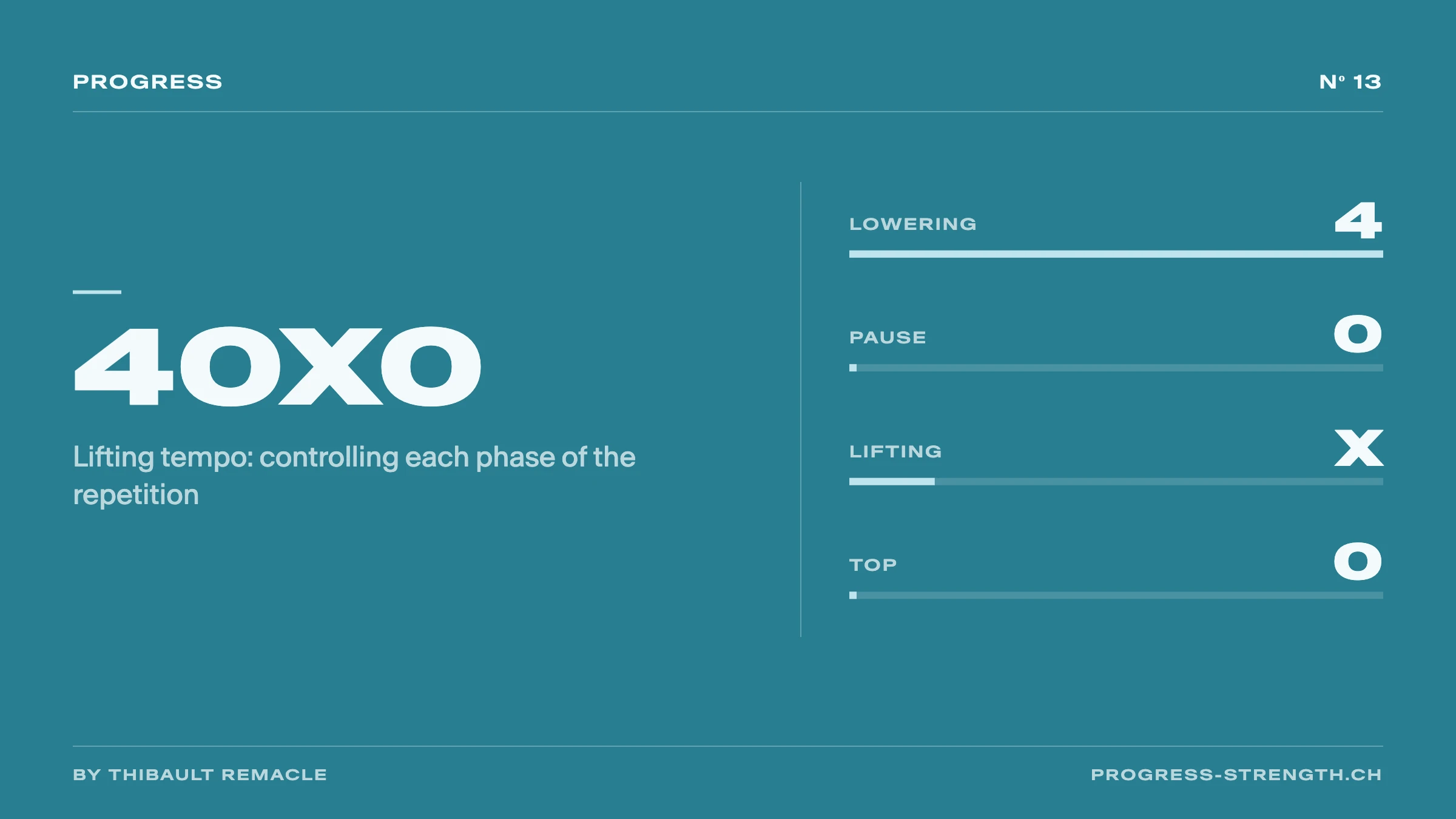
The four numbers are seconds, always in the same order:
So 3-1-1-0 means three seconds down, one second pause, one second up, no pause at the top. An X means as fast as possible: the weight may move slowly when it is heavy, but your intention is to accelerate it.
A 100 kg squat lowered in three seconds with a pause is not the same lift as a 100 kg squat dropped and bounced out of the bottom. If the tempo changes from week to week, so does the exercise, and comparing loads becomes meaningless. A fixed tempo turns the log book into real data. When the weight goes up at the same tempo, you are genuinely stronger.
Tempo controls how long each set lasts, the time under tension. Shorter, heavier sets favor strength. Longer sets favor muscle growth. As a rough guide, sets under about 20 seconds sit on the strength side, and sets of 40 seconds or more sit on the hypertrophy side. Tempo and repetitions together put each set where it belongs in the phase.
A controlled lowering phase keeps you in position. A pause at the bottom removes the bounce, so the muscle has to do the work instead of momentum. That makes heavy training safer, especially for tendons and joints that are not used to load.
Tempo is a tool, not a magic ingredient. Research on repetition speed shows that muscle growth is similar across a wide range of tempos, roughly half a second to eight seconds per repetition. Very slow repetitions, beyond about ten seconds, seem to work less well. What drives results is still the same: enough hard sets, close enough to failure, with progressive overload over time.
So no, a slower tempo is not automatically better. The point is control and consistency, not making sets longer for the sake of it.
Tempo gives each repetition a purpose: comparable loads, the right time under tension and cleaner technique. It doesn't replace hard work, it makes hard work measurable. That is why it is on every program at Progress.
Periodized programming and evidence-based nutrition, one-to-one in Lausanne or online.
Book a discovery call