When a supplement survives more than 30 years of research, hundreds of studies and regular attacks in the media, it deserves your attention. Creatine is that supplement.
Creatine was discovered in 1832 by the French chemist Michel Eugène Chevreul, who isolated it from meat. He named it after the Greek word for flesh, kreas. Over the following century, scientists worked out its central role in muscle energy.
The turning point came in 1992. A team led by Roger Harris showed, with muscle biopsies, that taking creatine monohydrate raised muscle creatine content by around 20%. The same year, British sprinters at the Barcelona Olympics were reported to be using it. Within a few years, creatine was in every serious gym bag.
Your muscles run on ATP. During a heavy set or a sprint, ATP is used up within seconds. Phosphocreatine, stored in the muscle, regenerates it almost instantly. More creatine stored means more phosphocreatine, which means you can produce high force a little longer and recover faster between efforts.
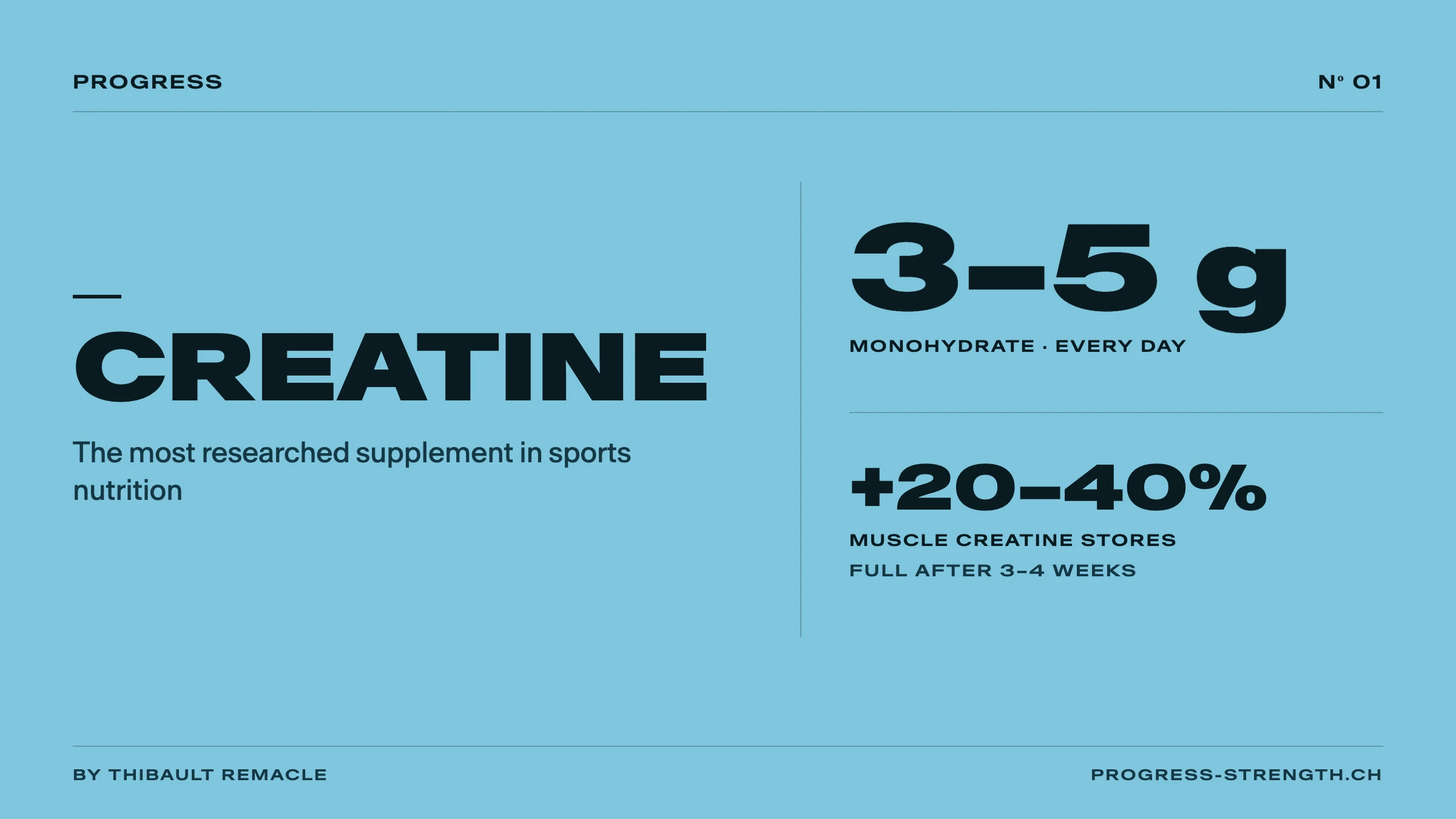
Your body makes about 1 gram a day, mainly in the liver and kidneys, and a diet with meat and fish adds roughly another gram. About 95% ends up in skeletal muscle. But natural stores are rarely full. Supplementation fills them, typically by 20 to 40%. Vegetarians start lower and usually respond more.
The International Society of Sports Nutrition describes creatine monohydrate as the most effective nutritional supplement available for increasing high-intensity exercise capacity and lean body mass. The findings that keep coming back:
The brain also uses creatine to recycle energy. Systematic reviews of randomized trials have found small improvements in memory with supplementation, more pronounced in older adults, vegetarians and situations of stress or sleep deprivation. It is not a miracle nootropic, but it is one more good reason to take it.
Cheap, safe and backed by more research than almost anything else on the shelf. If you train seriously and you are not taking creatine, you are leaving results on the table. 3 to 5 grams of monohydrate a day. That's it.
A first meeting at the gym or via Zoom to discuss your goals and see if we’re the right fit.