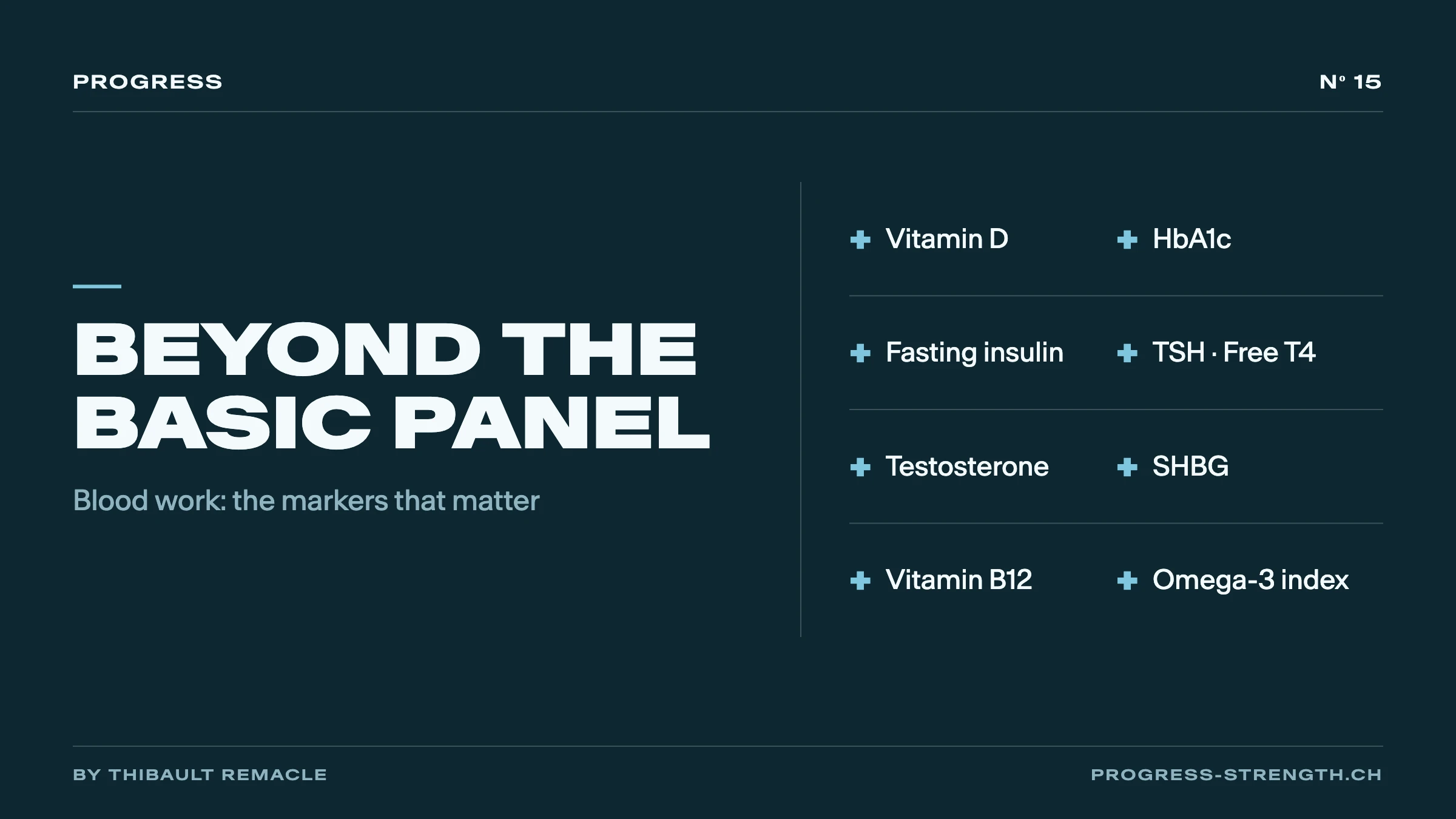
Most people get a basic blood test once a year, see "within range" everywhere and move on. A basic panel is designed to detect disease. It says much less about whether you are in good shape to train, recover and age well. A few extra markers change that.
This article is general information, not medical advice. Blood tests are prescribed and interpreted by a doctor.
Useful, but incomplete.
Ferritin reflects your iron stores. Low iron means fatigue, poor recovery and lower performance, often long before anemia appears in the blood count. Especially relevant for menstruating women, endurance athletes and vegetarians.
In Switzerland, a large part of the population is low in winter. Low levels are linked to fatigue, weaker muscles and bone health. We covered optimal levels in a separate article.
Fasting glucose is a snapshot. HbA1c reflects your average blood sugar over about three months. Fasting insulin, combined with glucose, shows insulin resistance years before glucose itself goes up. That is the window in which training and nutrition have the biggest effect.
Each atherogenic particle carries one ApoB molecule, so ApoB counts the particles that drive plaque in the arteries. Many cardiologists consider it a better risk marker than LDL cholesterol alone, especially when the two disagree.
Lipoprotein(a) is largely genetic and an independent risk factor for heart disease. It barely changes with lifestyle, so measuring it once in a lifetime is usually enough. If it is high, your doctor will want to manage other risk factors more strictly.
High-sensitivity CRP is a marker of low-grade inflammation, linked to cardiovascular risk. Do not test right after an infection or a very hard session, as both raise it temporarily.
The thyroid regulates metabolism. An underactive thyroid can explain fatigue, weight gain and feeling cold despite doing everything right.
One result is a photo. Several results over time are a film. Changes in your own markers over months, while your training and nutrition change, tell you far more than one value compared with a population range.
A basic panel tells you whether something is wrong. A few extra markers tell you how well you are doing, and where to act. At Progress, blood work is prescribed and interpreted by our partner physician, and we translate it into concrete changes in training and nutrition.
Periodized programming and evidence-based nutrition, one-to-one in Lausanne or online.
Book a discovery call